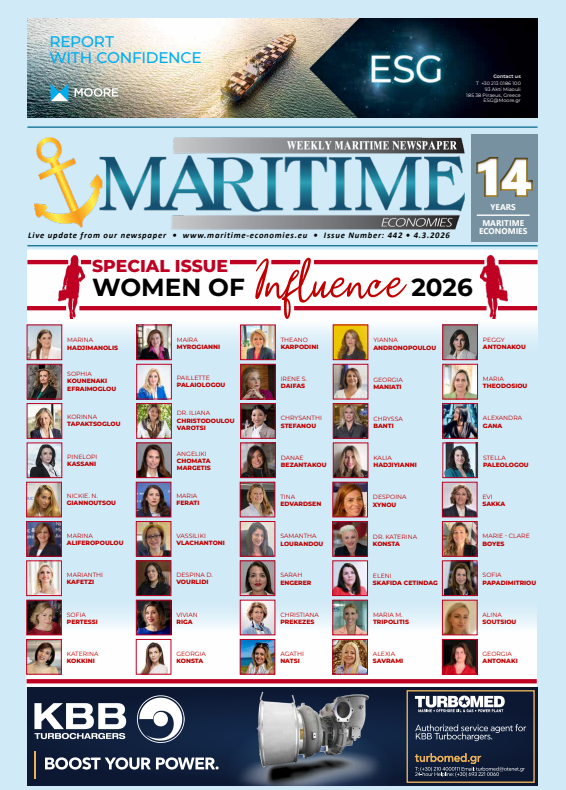
Woman of Influence Interview Questions – Paillette Palaiologou
1. In today’s world, it is becoming increasingly common for women to lead not only small businesses but also major global corporations. To what factors do you attribute this rise and establishment of female leadership in the business sector?
The rise of women in business leadership reflects a broader shift in how effective leadership is defined. In complex global industries like maritime, performance depends more on the ability to build alignment, manage uncertainty, and guide organizations through long-term transformation. These expectations have widened the leadership profile and naturally opened space for more diverse leaders.
In my experience, leadership is not about the individual but about enabling collective performance. Creating a culture where expertise is respected, different perspectives are heard, and people feel both empowered and accountable is what drives sustainable results. In a technical sector like ours where safety, innovation, and operational excellence must coexist, this approach is not a soft dimension; it is a business requirement. Stronger governance, clearer performance criteria, and greater transparency have also reduced structural silos and supported a more merit-based leadership pipeline.
At the same time, industries facing digital, environmental, and regulatory transformation benefit from leadership that is collaborative, adaptable, and long-term in outlook. Organizations increasingly recognize that diversity in leadership strengthens decision-making and better reflects the global markets they serve.
This evolution is positive not only for women, but for business itself: broader representation enhances resilience and improves the quality of decisions in a more complex world.
2. Nowadays, geopolitical developments are shifting rapidly and in unprecedented ways, even within established alliances. Given these volatile conditions, how challenging is it for you to plan your future business moves?
Geopolitical volatility has increased, but for us it does not change our direction — it reinforces the importance of our role.
Developments across Eastern Europe, the Mediterranean, the Middle East, Africa, and India, from the Russia–Ukraine war and energy market disruption to trade barriers and tariff uncertainty, directly affect trade flows, fuel availability, shipbuilding strategies, and investment timing. Planning therefore cannot rely on a single scenario; resilience comes from preparing for multiple possible futures.
For Bureau Veritas Marine & Offshore, this means helping clients find their path to operate and invest with confidence despite uncertainty.
Regulation has become a core business variable. The IMO net-zero framework, evolving GHG fuel intensity rules, and measures such as EEXI and CII influence asset values and operational strategies, while key parameters remain in flux. Through close monitoring of IMO and EU developments, participation in technical discussions, and impact assessments on fuels and compliance economics, we help clients understand how different regulatory outcomes could affect their fleets and investments.
Fuel and technology decisions are equally shaped by geopolitical and economic security considerations. Shipowners have to balance decarbonization with access to reliable and affordable energy. Our expertise on LNG, ammonia, hydrogen, and other alternative fuels and emerging technologies — supported by pilot projects and rule development — focuses on making these options technically robust and safer, alongside realistic evaluations of their economic implications.
Shifts in trade policy and regional dynamics are also influencing shipbuilding and fleet planning. Our classification, advisory, and digital services support risk management across the asset lifecycle, from design and fuel readiness to operational performance. Solutions such as VeriSTAR Green, My Fuel Consumption, and OptiCARBON™ translate regulatory and technical complexity into practical decision-support.
Volatility makes planning more demanding, but it also underscores the value of a long-term, technically grounded partner. Our role is to bring clarity where there is uncertainty, enabling clients to protect economic resilience today while preparing for the maritime sector’s structural transition.
3. Tell us about your personal professional journey so far.
I’ve built a career in the maritime and classification industry over the past three decades, gradually advancing through key leadership roles. My journey began at Oceanbulk Maritime S.A., where I gained invaluable experience in technical management, ship repairs, and classification matters.
In 2005, I joined Bureau Veritas (BV) as a Marine Center Surveyor, and over time, I took on more senior leadership roles, overseeing business development and regional operations.
Today, as Senior Vice President of EMA at Bureau Veritas Marine & Offshore, I lead strategic initiatives across Eastern Europe, the Mediterranean, the Middle East, India, and Africa, shaping and expanding my influence in the global maritime sector.
Based in Athens, I’ve spent thirty years in the shipping industry, combining my technical expertise as a naval architect and marine engineer, with a deep understanding of the market. My experience has allowed me to lead efforts in securing pioneering projects and major new clients, continuing to drive innovation and growth in the industry.